Tutorial: www.kaggle.com
Three Approaches
1. Drop Categorical Variables
The easiest approach to dealing with categorical variables is to simply remove them from the dataset. This approach will only work well if the columns did not contain useful information.
2. Ordinal Encoding
Ordinal encoding assigns each unique value to a different integer.

This approach assumes an ordering of the categories: “Never” (0) < “Rarely” (1) < “Most days” (2) < “Every day” (3).
This assumption makes sense in this example, because there is an indisputable ranking to the categories. Not all categorical variables have a clear ordering in the values, but we refer to those that do as ordinal variables. For tree-based models (like decision trees and random forests), you can expect ordinal encoding to work well with ordinal variables.
3. One-Hot Encoding
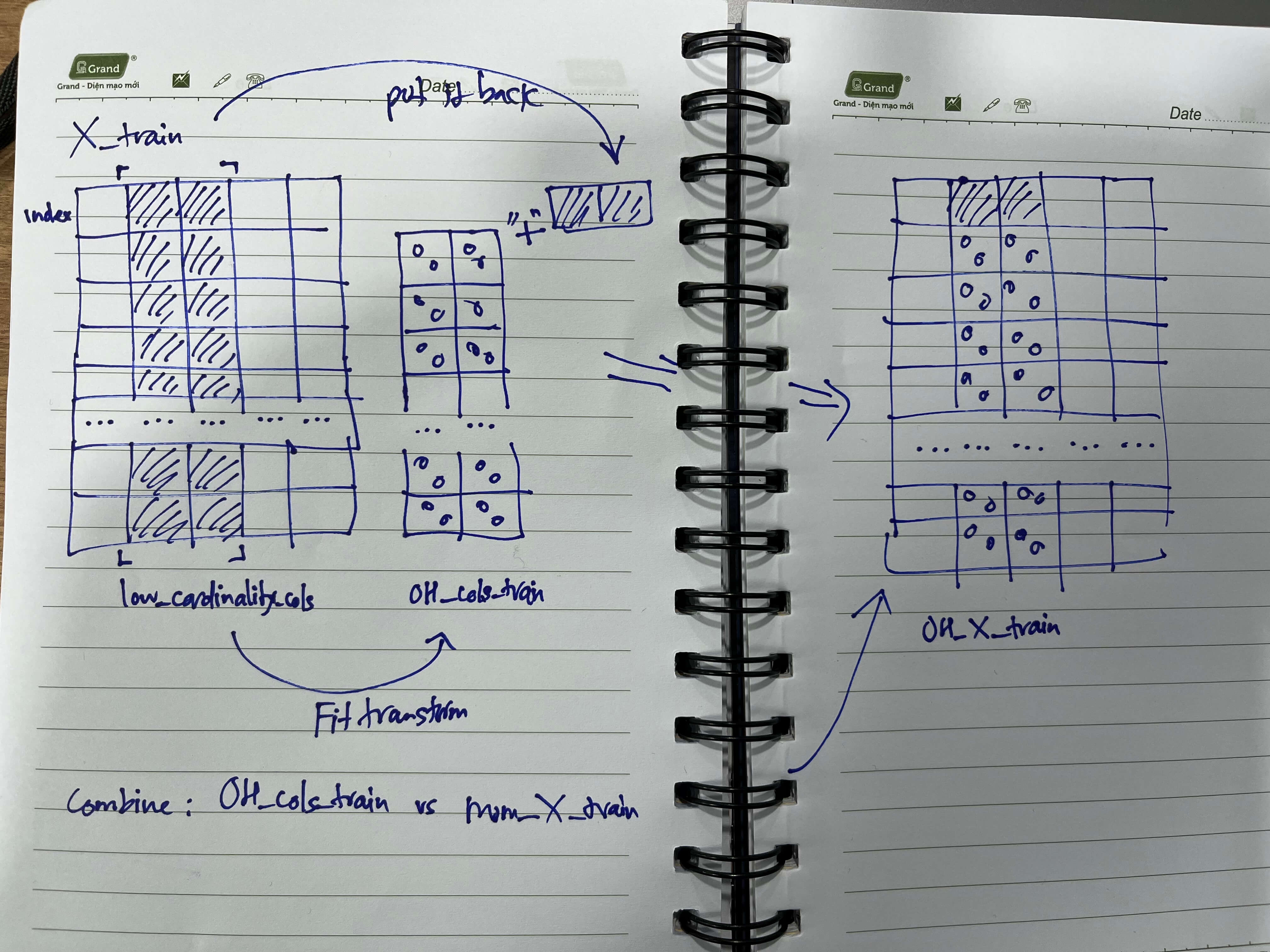
One-hot encoding creates new columns indicating the presence (or absence) of each possible value in the original data. To understand this, we’ll work through an example.

In the original dataset, “Color” is a categorical variable with three categories: “Red”, “Yellow”, and “Green”. The corresponding one-hot encoding contains one column for each possible value, and one row for each row in the original dataset. Wherever the original value was “Red”, we put a 1 in the “Red” column; if the original value was “Yellow”, we put a 1 in the “Yellow” column, and so on.
In contrast to ordinal encoding, one-hot encoding does not assume an ordering of the categories. Thus, you can expect this approach to work particularly well if there is no clear ordering in the categorical data (e.g., “Red” is neither more nor less than “Yellow”). We refer to categorical variables without an intrinsic ranking as nominal variables.
One-hot encoding generally does not perform well if the categorical variable takes on a large number of values (i.e., you generally won’t use it for variables taking more than 15 different values).
Example